
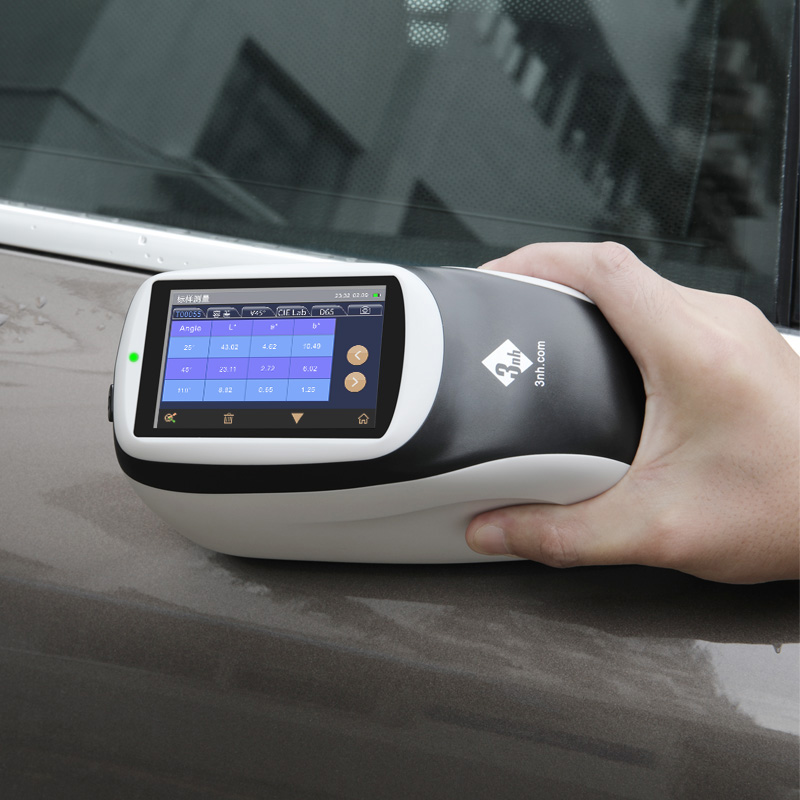
During the painting process, the instability of raw materials and dyeing processes can lead to color differences between the same and different batches of automotive paint. To accurately assess the color of automotive paint and control its color quality, a colorimeter can be used. This article introduces how to use a colorimeter to detect color differences in automotive paint. Interested friends can learn more!
- Reasons for color difference in car paint:
- Floating color and bleeding caused by the paint itself
Floating color: Floating color is caused by pigments with significantly different densities, which can easily lead to color distribution differences between the upper and lower layers, resulting in inconsistent color between the surface and interior of the coating. Examples include gray paint made with carbon black and titanium dioxide, and light blue paint made with phthalocyanine blue and titanium dioxide. Uneven evaporation of solvent during drying of the wet film creates a surface tension difference, leading to convection, which is the driving force behind floating color.
Color bleeding: Color bleeding is when the color of the primer seeps into the topcoat, causing the topcoat to be stained and discolored.
(1) The primer also contains organic pigments with poor solvent resistance; they are dissolved by the topcoat and penetrate into the topcoat.
(2) The topcoat contains a strong solvent and the primer is fully dried before applying the topcoat.
- Construction process
(1) Color difference caused by paint floating color or paint sedimentation, uneven stirring
(2) Cross contamination caused by improper cleaning of spraying tools
(3) The paint film thickness is thinner or thicker than the standard or the baking conditions are incorrect.
- Inspection standards
(1) Inconsistent standards: different assessment standards and models
(2) Different testing instrument models or different measurement methods
(3) Color migration of standard board
- Materials
(1) The materials used are different or not matched, and there is a large color difference between batches
(2) The base material is uneven and has different surface roughness, which will cause uneven absorption of the applied paint and cause color difference of the coin.
(3) The original paint on the surface of the coated object has lost its gloss and faded, and the scratches caused by spraying are repaired locally.
- Paint problems
(1) Uneven paint mixing
(2) The paint fades due to wind, sun and rain.
- Incorrect method
(1) Improper spraying method, too wet or too dry, incorrect spray gun caliber and spray pressure
(2) Inaccurate color matching or incorrect selection of differential color formula.
What should I do if there is color difference in car paint? How can I prevent it?
(1) Strengthen the inspection of paint purchases. The topcoat of the same color should be controlled from one manufacturer.
(2) The paint should be diluted appropriately to prevent it from crossing the stream.
(3) Prevent paint from floating and bleeding
(4) Tools should be thoroughly cleaned before painting, especially the paint pipes must be cleaned when changing colors to avoid color mixing.
(5) Before painting, the substrate must be processed properly, smooth and have consistent surface roughness.
(6) The paint should be fully stirred before use
(7) Before formal spraying, spray a board with the prepared paint and observe the color at different angles under different lights, compare the difference with the original car color, and ensure the color matching is accurate.
- Multi-angle spectrophotometer controls the color quality of automotive paint:
To accurately assess color variations in automotive paint and control the quality of textile products, multi-angle spectrophotometers can be used. Multi-angle spectrophotometers make color processing of automotive paint more convenient. We use multi-angle spectrophotometers and computer color matching systems to modify the color of automotive paint products, thereby reducing color variations between products within the same batch.
The multi-angle spectrophotometer can accurately assess the degree of color difference between two products. It automatically compares the color difference between the sample and the inspected product, and then outputs three sets of CIE-LAB data and four sets of color difference data after color comparison: ΔE, ΔL, Δa, and Δb.
The principle behind this approach is to measure the sample’s tristimulus values (x, y, and z) by integrating them, and then calculate parameters such as the sample’s chromaticity coordinates. Typically, a filter is placed over the detector to correct the detector’s relative spectral sensitivity (S(λ)) to the CIE-recommended spectral tristimulus values (x(λ), y(λ), and z(λ). When these three light detectors receive light, the sample’s tristimulus values (X, Y, and Z) can be measured with a single integration. The filter must meet the Luther condition to accurately match the light detector.
Car paint sprayers can colorize car paint with large color differences based on the data measured by the multi-angle spectrophotometer, thereby ensuring the consistency of product color and reducing corresponding losses.
- How to deal with color difference in car paint
First, the color ratio is not adjusted properly, so it is recommended to repaint.
Second, if the color appears darker within a month after painting, it may be because the paint hasn’t dried completely. However, if it’s still darker after a month, the color is incorrect. You can have the car repainted, but you don’t need to repaint the entire car. Using a transitional paint technique can make similar colors appear less noticeable. If you’re concerned about color, it’s best to use imported paint to prevent future discoloration.
Suggestions for dealing with color difference in car paint:
It’s best not to spray too much. If you spray too many times, the car body will peel like dry skin on your hands. This is especially true for large areas like the roof and hood. After the paint is completely dry, perform body care, waxing, or glazing.
Best Practices for Measuring Automotive Paints and Coatings
The following are the best practices adopted by OEMs, Tier 1 suppliers, and refinish centers.
- Surface Preparation
Wipe the measurement area with isopropyl alcohol and lint-free cloths so as to wipe off oils, dusts and residues. Light scattering of even microscopic particles can distort the results especially on high gloss or clear coats. The area should not be touched after cleaning because skin oils may distort gloss measurements and reflect color.
- Calibration of Equipment
This includes daily calibration of the spectrophotometer with traceable white, black, and gloss standards. Devices with high precision usually have inbuilt calibration tiles or have an auto-diagnostic feature that identifies drift. Make sure that periodic calibration against NIST traceable standards is carried out to comply with the ISO 17025 requirements.
- Use Consistent Illumination
Make lighting conditions standard by use of illuminants such as D65 (6500K daylight), A incandescent, or F11 (fluorescent) according to ASTM D2244 or CIE standards.
Never measure under mixed lighting, nor anywhere that has shifting natural light (such as near a window). Light booths, which are integrated, can be used to provide controlled conditions to get more reliable data validation.
- Control Environmental Variables
Make measurements under climate-controlled conditions to reduce the effects of parameters such as:
- Temperature (ideal: 21-23°C)
- Humidity (ideal: 45-55 %)
- Ambient light.
These conditions are assistive in the stabilization of the substrate and stable flake orientation in the newly applied or cured coating.