
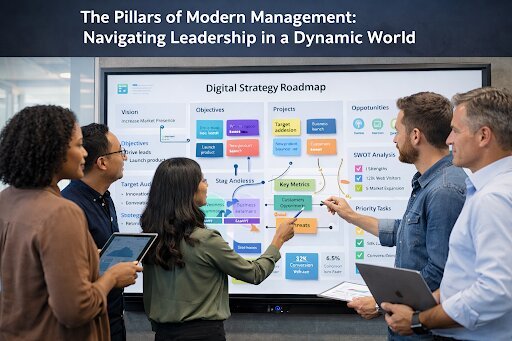
Welcome back to AnswerQues, your trusted hub for navigating the complexities of business, education, and professional growth. Whether you are an aspiring entrepreneur, a business student stepping into your first major courses, or a seasoned corporate leader, understanding the core principles of management is absolutely non-negotiable. The modern business landscape is constantly shifting, driven by rapid technological advancements, evolving workplace cultures, and highly globalized markets. To truly thrive, leaders must master the art of blending foundational management theories with modern, agile practices.
The Evolution of the Management Process
Historically, management was viewed through a strictly industrial lens—focused primarily on repetitive efficiency, rigid hierarchy, and top-down control. Today, the paradigm has completely shifted. Modern management is built on four crucial pillars: planning, organizing, leading, and controlling. However, the execution of these pillars requires far more adaptability and nuance than ever before.
Planning is no longer about rigid ten-year forecasts; it involves agile, short-term strategies that can pivot based on immediate market feedback. Organizing has moved away from siloed corporate departments toward cross-functional teams that collaborate seamlessly. With the rapid rise of remote and hybrid work environments, managers must build organizing structures that transcend physical office spaces. Digital collaboration tools have become the new boardroom, requiring leaders to be proficient in asynchronous communication and decentralized project management.

Leading with Empathy and Innovation
Perhaps the most significant transformation in recent years is how we actively define “leading.” Today’s workforce demands much more than just basic direction; they require inspiration, psychological safety, and emotional intelligence from their superiors. Managers must act as supportive coaches rather than strict dictators. They are tasked with fostering an inclusive environment where continuous innovation is encouraged, and where failure is treated as an inevitable stepping stone to long-term success.
Controlling, the final management pillar, has also heavily evolved. Rather than micromanaging employees’ daily tasks, modern control relies on data-driven metrics, transparent Key Performance Indicators (KPIs), and continuous feedback loops that empower teams to self-correct and grow autonomously.
Building a Strong Academic Foundation
While hands-on practical experience is invaluable in the corporate world, truly effective leadership is grounded in robust academic theory. You cannot build a stable skyscraper without a solid architectural blueprint, and you certainly cannot build a successful organization without understanding the time-tested principles of organizational behavior, corporate strategy, and human resource management.
For students and professionals looking to deepen their understanding of these complex concepts, having the right educational resources on hand is crucial. One of the most comprehensive and highly respected resources in the academic world is Management (15th Edition) by Richard L. Daft (ISBN 9798214042367). This textbook perfectly bridges the gap between traditional management principles and the highly innovative practices required in today’s fast-paced workplace. It is an essential read for anyone serious about mastering the intricacies of corporate leadership, organizational success, and competitive advantage.

If you want to ensure you are fully equipped for your business courses or simply want to elevate your professional knowledge to the next level, you should download the textbook in PDF from this URL: https://textbooks.dad/product/management-15th-edition-daft-ebook/. Having digital access ensures you can study these critical strategic frameworks anytime, anywhere, right from your tablet or laptop.
Wrapping Up
As we continue to explore essential business strategies and career advice here on AnswerQues, always remember that great managers are made, not born. They are shaped by a relentless commitment to learning, adapting, and understanding the deeply human element of modern business. Whether you are managing a small local startup team or overseeing a massive multinational division, the underlying principles remain the same. Stay continuously curious, invest heavily in your ongoing education, and always prioritize the well-being of your team. The future of business belongs to those who are thoroughly prepared to lead with both strategic vision and deep empathy.